OpenAI's Next Move Could Destroy the SaaS Industry as We Know It
What if software applications become obsolete? OpenAI's rapid evolution toward AI agents and autonomous systems could fundamentally reshape—or even eliminate—traditional SaaS business models. Here's what businesses, developers, and founders need to know.

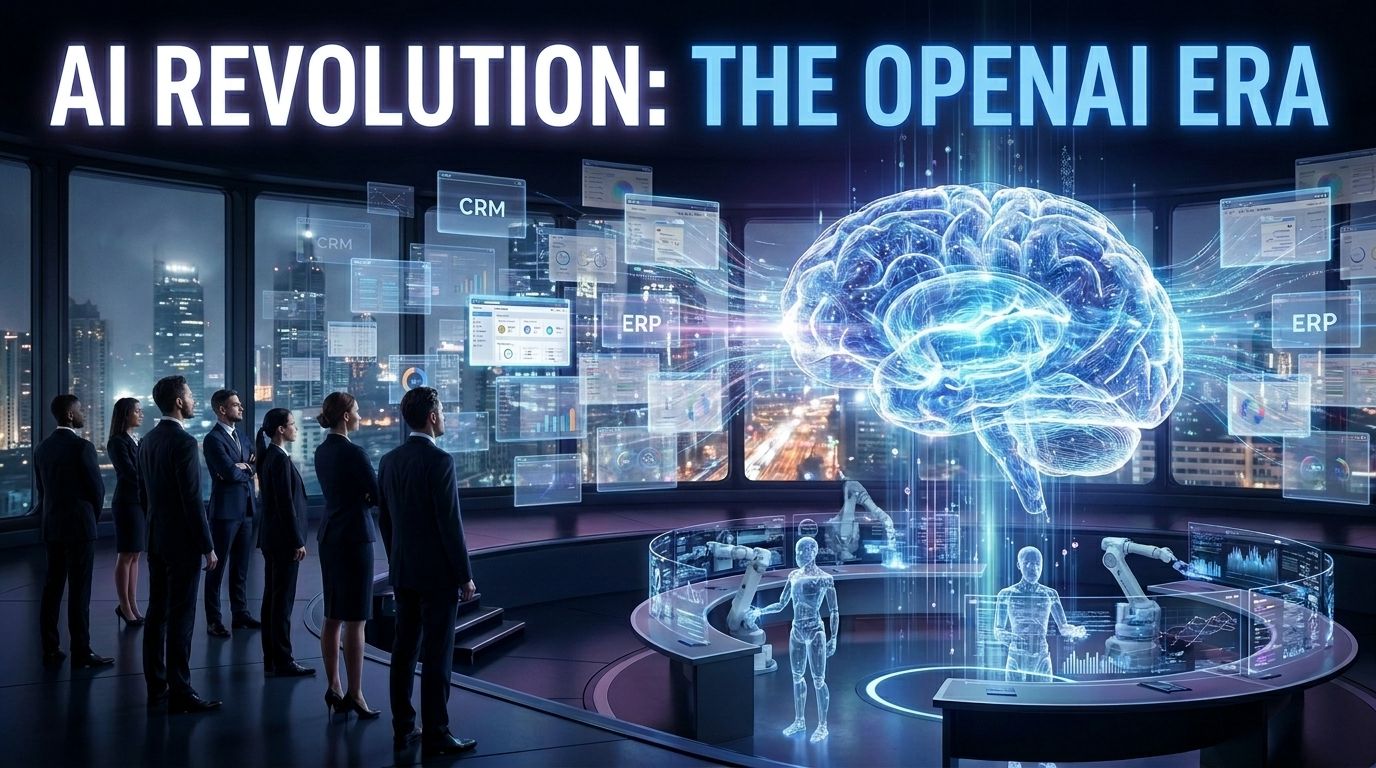
OpenAI's Next Move Could Destroy the SaaS Industry as We Know It
For more than two decades, the Software-as-a-Service (SaaS) industry has dominated the technology landscape.
Need customer relationship management? Buy a CRM.
Need project management? Subscribe to a project management platform.
Need accounting software? Pay another monthly subscription.
The SaaS model has become one of the most successful business models in history, creating thousands of startups and trillions of dollars in market value.
But a new threat is emerging.
And it doesn't look like traditional competition.
It looks like artificial intelligence.
As OpenAI continues to push the boundaries of AI agents, reasoning systems, and autonomous workflows, many industry experts are beginning to ask a provocative question:
What happens when AI can do the job of the software itself?
The Traditional SaaS Model
The SaaS industry is built on a simple concept:
Users learn software.
Businesses pay recurring subscriptions.
Employees spend time navigating dashboards, forms, menus, workflows, reports, and integrations.
Every SaaS company essentially creates a specialized interface for solving a specific problem.
Examples include:
- Customer management
- Marketing automation
- Project tracking
- Accounting
- Human resources
- Customer support
- Analytics
- Content management
The software acts as the intermediary between the user and the outcome.
But AI changes that relationship completely.
The Shift From Software to Outcomes
Imagine telling an AI:
"Find all leads generated in the last 30 days, identify the highest-value prospects, draft personalized outreach emails, schedule follow-ups, and generate a conversion report."
Today this might require:
- CRM software
- Marketing software
- Email automation tools
- Reporting dashboards
- Multiple integrations
Tomorrow?
A single AI agent could perform the entire workflow.
Users no longer interact with software.
They interact with outcomes.
And that is where the threat to SaaS begins.
Why OpenAI Is Different
Previous technology waves improved software.
OpenAI may eliminate the need for much of it.
Large language models are rapidly evolving into systems capable of:
- Reasoning
- Planning
- Decision-making
- Tool usage
- Workflow execution
- Autonomous task completion
Instead of building software interfaces, companies may increasingly build AI-powered capabilities.
The interface becomes conversation.
The product becomes intelligence.
The Rise of AI Agents
AI agents represent the next major evolution.
Rather than answering questions, agents can:
- Take actions
- Execute tasks
- Coordinate systems
- Monitor processes
- Learn preferences
- Complete objectives independently
For example:
Traditional SaaS Workflow
- Log into CRM
- Search customer records
- Export data
- Analyze results
- Create report
- Send recommendations
AI Agent Workflow
"Analyze our customer database and show me the biggest revenue opportunities."
Done.
The difference is dramatic.
Every SaaS Category Is at Risk
Not all SaaS businesses will disappear.
But many could become vulnerable.
Customer Support Platforms
AI agents can handle conversations, ticket resolution, and knowledge management.
Marketing Platforms
AI can create campaigns, write content, optimize targeting, and analyze performance.
Analytics Tools
Instead of dashboards, users ask questions directly.
Project Management Software
AI agents can coordinate tasks, assign work, monitor progress, and provide updates.
HR Platforms
AI can manage onboarding, documentation, employee assistance, and policy guidance.
Content Management Systems
AI can generate, organize, update, and distribute content automatically.
Many SaaS products may become features rather than standalone businesses.
The Great SaaS Consolidation
Historically, companies purchased dozens of software tools.
A typical business might use:
- CRM
- Project Management
- Accounting
- Marketing Automation
- Documentation
- Customer Support
- Analytics
That's a lot of subscriptions.
AI agents introduce a different model.
Instead of buying ten applications, businesses may purchase:
- One intelligent platform
- Several specialized agents
- Access to AI capabilities
This could significantly reduce software fragmentation.
What Happens to SaaS Startups?
This is where things become interesting.
Many startups today are essentially:
Workflow + Interface + Database
AI can increasingly replicate those components.
As a result:
Vulnerable Startups
Companies offering simple workflows with limited differentiation.
Safer Startups
Companies with:
- Proprietary data
- Strong network effects
- Industry expertise
- Regulatory advantages
- Unique infrastructure
The value shifts from interface design to intelligence and data ownership.
Why Developers Should Pay Attention
Software developers are not becoming obsolete.
But the nature of development is changing.
Future developers may spend less time:
- Building CRUD interfaces
- Creating dashboards
- Designing forms
And more time:
- Building AI systems
- Creating agent architectures
- Managing data pipelines
- Designing autonomous workflows
- Ensuring security and governance
The opportunity remains enormous.
The skill set evolves.
The New Competitive Advantage
In the AI era, winning companies may not have:
- The best interface
- The most features
- The largest menu system
Instead, they may have:
Better Data
Unique datasets create defensible advantages.
Better Models
Superior intelligence creates better outcomes.
Better Automation
The company that completes work fastest wins.
Better Trust
Security, compliance, and reliability become critical.
Will SaaS Actually Die?
Probably not.
But it will likely transform dramatically.
History suggests technologies rarely disappear overnight.
Instead:
- Old models shrink.
- New models emerge.
- Market leaders adapt.
- Slow movers struggle.
Many SaaS companies will successfully integrate AI.
Others may become invisible infrastructure powering AI agents behind the scenes.
The winners won't necessarily be those with the most software.
They'll be those delivering the best results.
What This Means for Entrepreneurs
If you're building a startup today, ask yourself:
"If OpenAI released a powerful autonomous agent tomorrow, would my product still matter?"
That's a difficult question.
But it's the right one.
Founders should focus on:
- Proprietary data
- Vertical expertise
- Industry-specific intelligence
- AI-first experiences
- Strong customer relationships
Building another dashboard may no longer be enough.
The Future: Software Becomes Invisible
The most profound possibility is that software itself becomes invisible.
Users won't care:
- Which database is used
- Which APIs are connected
- Which applications are running
They'll simply state objectives.
AI systems will determine how to achieve them.
This represents a fundamental shift from:
Software-Centric Computing
to
Outcome-Centric Computing
And OpenAI appears determined to accelerate that transition.
Final Thoughts
The SaaS industry is not disappearing tomorrow.
But the foundations of the industry are being challenged in ways we've never seen before.
OpenAI's advances in AI agents, reasoning models, and autonomous workflows suggest a future where software interfaces become less important and outcomes become everything.
For businesses, founders, developers, and investors, the message is clear:
The next decade may not be about building more software.
It may be about building intelligence.
And that could change the technology industry forever.
More to read?
Browse all articles on the blog.