Prompt-to-UI Is Here: Will Designers Still Need to Draw Wireframes?
AI can now transform simple text prompts into complete user interfaces within seconds. As Prompt-to-UI tools become increasingly powerful, many designers are asking a critical question: will wireframing become obsolete, or is the role of designers evolving rather than disappearing?

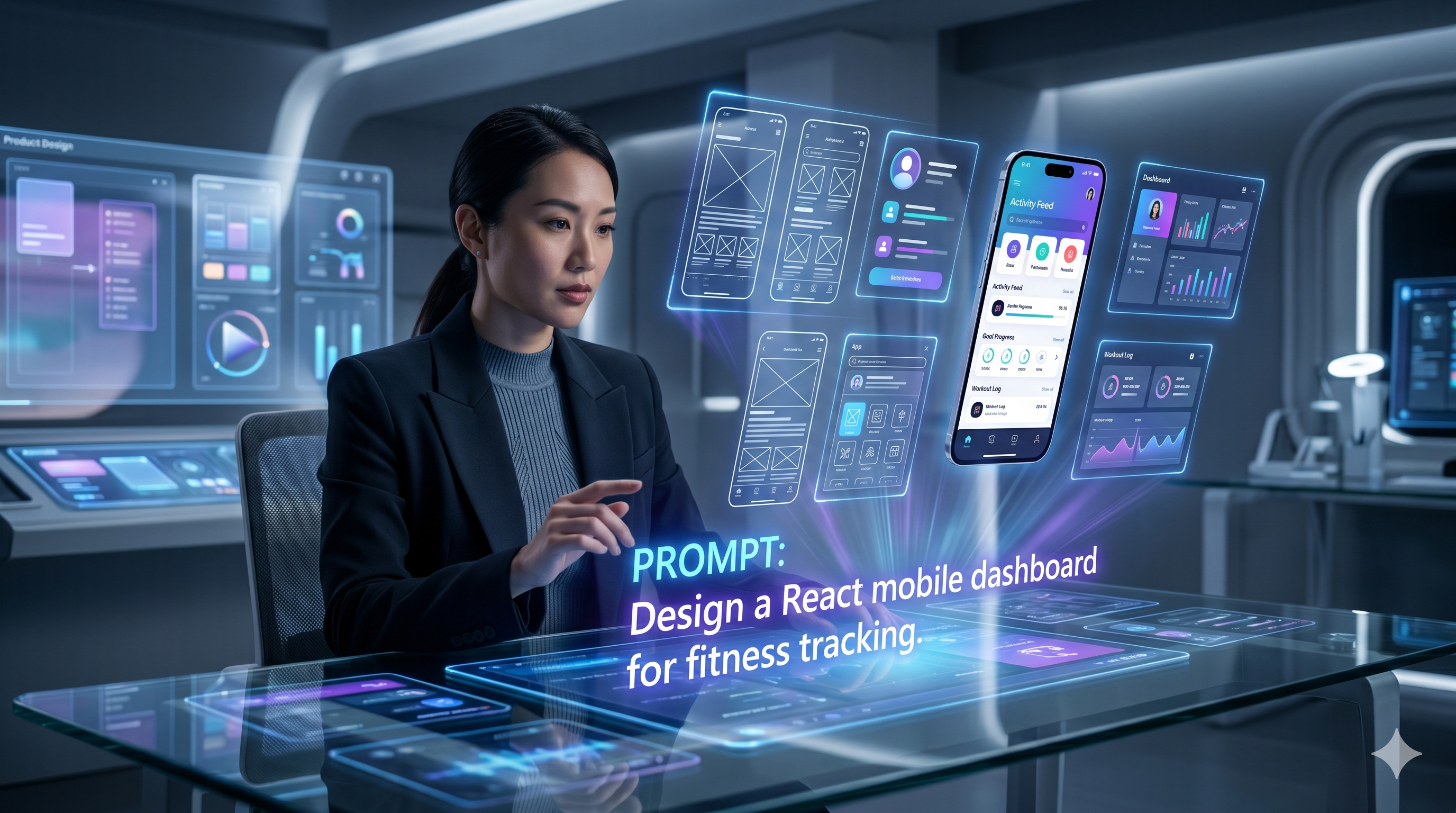
Prompt-to-UI Is Here: Will Designers Still Need to Draw Wireframes?
For decades, wireframes have been one of the most important artifacts in product design.
Before a product was built, designers would sketch layouts, arrange components, define user flows, and communicate ideas through low-fidelity wireframes. These wireframes acted as the bridge between business requirements and actual implementation.
Today, however, a new wave of AI-powered tools is challenging that workflow.
Instead of spending hours drawing screens manually, designers can simply write:
"Create a modern fintech dashboard with account balances, transaction history, spending analytics, and a responsive mobile layout."
Within seconds, AI generates a complete UI.
Welcome to the era of Prompt-to-UI.
The question is no longer whether AI can create interfaces.
The question is whether designers will still need to draw wireframes at all.
What Is Prompt-to-UI?
Prompt-to-UI refers to AI systems that generate user interfaces directly from natural language descriptions.
Rather than manually placing components on a canvas, users describe what they want and AI converts those instructions into visual designs.
Modern tools can generate:
- Landing pages
- Mobile app screens
- Dashboard interfaces
- E-commerce experiences
- Design system components
- Interactive prototypes
Some tools can even generate production-ready code alongside the design.
This dramatically reduces the time between idea and implementation.
Why This Technology Is Advancing So Quickly
Several breakthroughs have converged at the same time:
Large Language Models
AI now understands user intent, design terminology, and product requirements.
Multimodal AI
Modern models can interpret text, images, sketches, and screenshots simultaneously.
Design Pattern Learning
AI has learned millions of interface patterns from websites, mobile apps, and design systems.
Frontend Code Generation
AI can translate visual designs directly into React, HTML, CSS, Flutter, or React Native code.
The result is a system capable of acting as both designer and developer for many routine tasks.
The Traditional Wire framing Process
Historically, the process looked like this:
Idea → Research → Wireframes → Mockups → Prototype → Development
Each phase required separate tools and significant manual effort.
Designers often spent days creating screens before receiving feedback.
Every revision required more time.
Prompt-to-UI introduces a much shorter cycle:
Idea → Prompt → Generated UI → Refinement → Development
What once took days can now happen in minutes.
Why Designers Are Paying Attention
The productivity gains are impossible to ignore.
Imagine designing:
A Dashboard
Instead of drawing charts and widgets manually:
"Create an analytics dashboard for an e-commerce business with revenue trends, customer growth metrics, and inventory alerts."
The UI appears instantly.
A Mobile App
Instead of sketching multiple screens:
"Design a meditation app with daily sessions, progress tracking, and calming visual aesthetics."
AI generates multiple concepts immediately.
A SaaS Product
Instead of building wireframes from scratch:
"Create a project management platform inspired by modern enterprise software."
Several layouts are generated within seconds.
This changes the economics of design work.
Does This Mean Wireframes Are Dead?
Not exactly.
What is disappearing is the manual production of basic wireframes.
What remains valuable is the thinking behind them.
Many people confuse wireframes with design.
They are not the same thing.
Wireframes are simply a tool.
The real value comes from:
- Understanding user needs
- Defining workflows
- Solving business problems
- Prioritizing information
- Designing user journeys
- Making strategic decisions
AI can generate layouts.
It cannot fully understand organizational goals, customer psychology, and product strategy at the same level as experienced designers.
The New Role of Designers
As Prompt-to-UI tools mature, designers may spend less time drawing and more time directing.
The future designer may resemble a creative strategist rather than a screen creator.
Responsibilities will increasingly include:
Prompt Engineering
Crafting precise instructions to guide AI systems.
UX Strategy
Defining user journeys and interaction patterns.
Design System Governance
Ensuring consistency across products.
Human-Centered Validation
Testing whether generated designs actually solve user problems.
AI Supervision
Reviewing, refining, and improving AI-generated outputs.
The designer becomes the architect rather than the draftsperson.
What AI Still Struggles With
Despite impressive progress, Prompt-to-UI systems have limitations.
Business Context
AI often lacks a deep understanding of organizational objectives.
User Research
Generated interfaces may not reflect actual customer needs.
Accessibility
Many AI-generated designs still fail accessibility standards.
Innovation
AI tends to remix existing patterns rather than invent entirely new experiences.
Edge Cases
Complex enterprise workflows often require human judgment.
These limitations ensure that human expertise remains critical.
What This Means for Frontend Developers
Prompt-to-UI is also changing frontend development.
Many tools now generate:
- React Components
- Next.js Applications
- React Native Screens
- Tailwind Layouts
- Design Tokens
- Component Libraries
Frontend engineers are increasingly becoming:
- System architects
- Performance specialists
- Accessibility experts
- AI workflow managers
Rather than coding every pixel manually, developers focus on creating scalable systems.
The Rise of AI-Native Product Teams
A new team structure is emerging.
Traditional Teams:
- Product Manager
- UX Designer
- UI Designer
- Frontend Developer
- QA Engineer
AI-Native Teams:
- Product Strategist
- AI-Assisted Designer
- AI-Assisted Developer
- Quality Reviewer
Smaller teams can now achieve what previously required significantly larger organizations.
This is one reason startups are moving faster than ever before.
Will Junior Designers Be Affected?
Probably more than senior designers.
Many entry-level design tasks involve:
- Wireframe creation
- Layout exploration
- Component arrangement
- Design variations
These are exactly the areas where AI excels.
As a result, future designers will need stronger skills in:
- Product thinking
- UX research
- Customer psychology
- Business strategy
- AI collaboration
The market will increasingly reward strategic thinking over tool proficiency.
The Future of Design
Five years from now, the design workflow may look very different.
A designer might begin by saying:
"Create a responsive healthcare platform optimized for elderly users, emphasizing accessibility, trust, and ease of navigation."
AI generates:
- User flows
- Wireframes
- Visual designs
- Interactive prototypes
- Production-ready code
The designer reviews, refines, and approves.
The creative process becomes dramatically faster while human judgment remains central.
Final Thoughts
Prompt-to-UI is not eliminating design.
It is eliminating friction.
Just as digital tools replaced pen-and-paper drafting, AI is beginning to replace repetitive interface creation.
The designers who thrive in this new era will not be those who draw the fastest wireframes.
They will be those who understand users, products, and business outcomes better than anyone else.
Wireframes may become optional.
Design thinking will become more valuable than ever.
The future belongs to designers who can collaborate with AI rather than compete against it.
More to read?
Browse all articles on the blog.