The Death of the Code Assistant: Inside Google’s Insane New AI Swarm (Antigravity 2.0 & WebMCP)
Forget basic AI autocomplete boxes. At Google I/O 2026, tech leaders dropped a bomb on the developer ecosystem: a terrifyingly powerful multi-agent engine called Antigravity 2.0 and a new web standard called WebMCP. Here is why software engineering will never be the same.

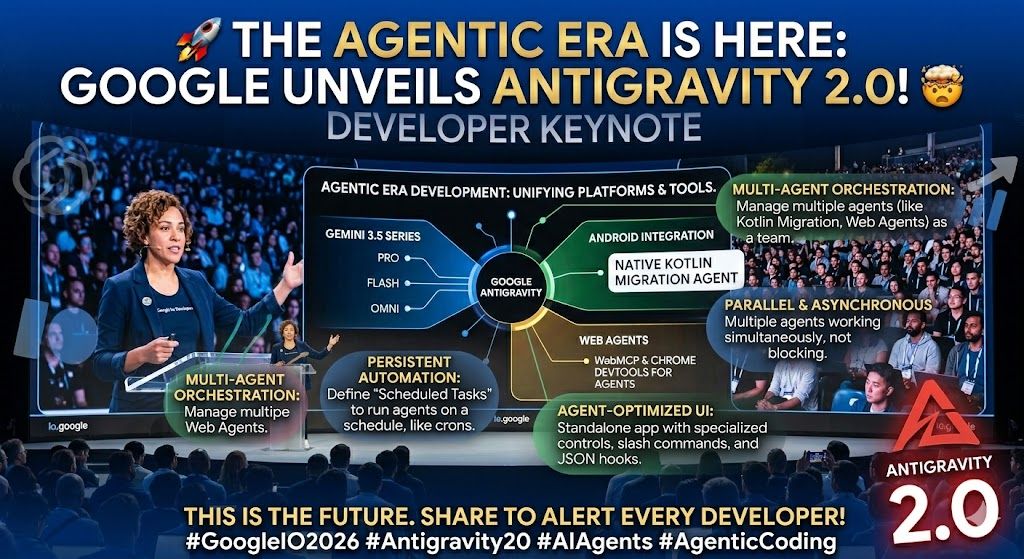
At Google I/O 2026, the developer keynote shifted from treating AI as an autocomplete feature to establishing it as autonomous infrastructure. Instead of simply expanding context windows or tweaking IDE chat panels, Google introduced two monumental technologies: Antigravity 2.0 and WebMCP (Web Model Context Protocol). Together, these releases form a comprehensive blueprint for the "Agentic Stack."
1. Google Antigravity 2.0: The Command Center for Multi-Agent Teams
When Google originally introduced Antigravity late last year, it was framed as an AI-powered Integrated Development Environment (IDE) built to challenge systems like Cursor. At I/O 2026, Google completely decoupled the core AI orchestration engine from the editor itself.
Antigravity 2.0 is now a standalone desktop application (available for macOS, Windows, and Linux) designed entirely around asynchronous, multi-agent collaboration.
Architectural Breakdown
Instead of tying an AI agent to a single file tree or a single active repository, Antigravity 2.0 elevates the workspace to the Project Level. A single project can now span multiple folders, services, and structural cloud configurations simultaneously.
The core desktop application acts as an agent manager interface, utilizing several major structural shifts:
- Dynamic Subagents & Parallel Processing: When handed a complex, massive issue (like migrating an entire framework), the primary supervisor agent can dynamically spin up sandboxed, ephemeral subagents. These subagents tackle hyper-focused micro-tasks in parallel—such as writing isolated unit tests or scaffolding boilerplate endpoints—without bleeding unnecessary tokens into the main supervisor's context window.
- Asynchronous Workspace & Artifacts: Software development is no longer locked into a single-turn conversational loop. Agents can run heavy background operations continuously without blocking the user. Outputs are treated as living "Artifacts" that developers can review, comment on, and edit side-by-side with the agent's log.
- Scheduled Tasks (Crons for AI Workers): Developers can configure native JSON crons to invoke agents automatically. An agent can wake up at 2:00 AM, ingest the latest main branch commits, run a security vulnerability scan, execute edge-case synthetic user tests, and present a fully formatted pull request to the human engineering team by sunrise.
The Antigravity Ecosystem Extensions
To make the engine universally accessible across any developer workflow, Google expanded Antigravity into a full-scale family of developer tooling:
- Antigravity CLI: A native Go-based terminal tool that completely replaces the legacy Gemini CLI, injecting the exact same agent runtime, hooks, and plugins directly into terminal-based workflows.
- Antigravity SDK: An open toolkit allowing enterprise engineering teams to programmatically host and script custom Antigravity agent behaviors directly on their private, internal server infrastructure.
- Managed Agents in Gemini API: A cloud-hosted shortcut allowing developers to spin up a fully provisioned, reasoning agent inside an isolated, secure Linux sandbox with a single API call.
The Live Stage Demo: To prove the operational power of this stack, Google engineers demonstrated an autonomous cluster of 93 subagents building a fully functional, foundational desktop operating system from scratch. The system completed the task in 12 hours for less than $1,000 in API compute. When the retro game Doom failed to boot due to an unconfigured keyboard driver, the engineer prompted Antigravity to write it. The app mapped the terminal sandbox, compiled the native code, and successfully loaded the game live on stage.
2. WebMCP: Giving Browser Agents a Sanctioned Front Door
While Antigravity 2.0 fixes how agents build software, WebMCP (Web Model Context Protocol) completely redefines how agents interact with the web.
Historically, browser-based AI automation has relied on screen scraping, parsing messy DOM layout trees, or using computer vision to guess click coordinates. This approach is highly brittle, token-expensive, and prone to breaking the moment a website shifts a layout button by three pixels.
Incubated via the W3C Web Machine Learning community group and heavily supported by Google, WebMCP acts as an experimental browser API standard that allows websites to cleanly expose deterministic "tools" directly to AI models.
From Scraping Pixels to Machine Contracts
WebMCP introduces a formalized machine-to-machine contract layer natively built into the web browser interface via the navigator.modelContext API. Instead of forcing an AI assistant to guess how an application functions, a WebMCP-enabled webpage provides a strict JSON schema declaring exactly what tools are available and what payloads they accept.
JavaScript
// Example: Registering a native WebMCP tool on a live webpage
navigator.modelContext.registerTool({
name: 'execute_booking',
description: 'Books a specific travel itinerary',
inputSchema: {
type: 'object',
properties: {
flightId: { type: 'string' },
seatPreference: { type: 'string' }
},
required: ['flightId']
}
}, async (params) => {
return fetch(`/api/book?id=${params.flightId}&seat=${params.seatPreference}`);
});
Key Structural Advantages
- Massive Token Efficiency: Passing a lightweight JSON schema to an LLM takes a fraction of the token overhead required to dump raw HTML layout dumps or accessibility maps into the prompt context.
- Bypassing Bot Protection: Because WebMCP operates through an explicit, user-sanctioned front door provided directly by the web browser's native API boundaries, agents can execute complex workflows without tripping brittle anti-scraping CAPTCHAs or Cloudflare blocks.
- Zero-Guess Execution: Hallucinations drop exponentially because the agent works directly with clean, deterministic data payloads instead of trying to infer state from shifting web visual layouts.
Implementation and Debugging Tooling
Google is kicking off active origin trials for WebMCP starting inside Chrome 149. To make the protocol immediately viable for engineers, Google rolled out Chrome DevTools for Agents. This dedicated, native debugging panel allows developers to step through, monitor, and inspect programmatic agent calls hitting their WebMCP endpoints in real time.
The Verdict: The Infrastructure of Tomorrow's Engineering
The takeaway from Google I/O 2026 is clear. The developer ecosystem is moving away from basic human-in-the-loop chat boxes and transitioning to highly structured, machine-optimized orchestration environments. By launching Antigravity 2.0 as a robust operational core and backing WebMCP as an open standard for web interactivity, Google has laid down the plumbing required to scale autonomous engineering from a novelty into an enterprise reality.
You can watch the Google I/O 2026 Insane AI Recaps to see the legendary live demo where Antigravity deployed a swarm of parallel agents to build an operating system from a completely blank slate and get a look at how this changes autonomous programming.
More to read?
Browse all articles on the blog.